Enclaves of Exception: Special Economic Zones and Extractive Practices in Nigeria by Omolade Adunbi
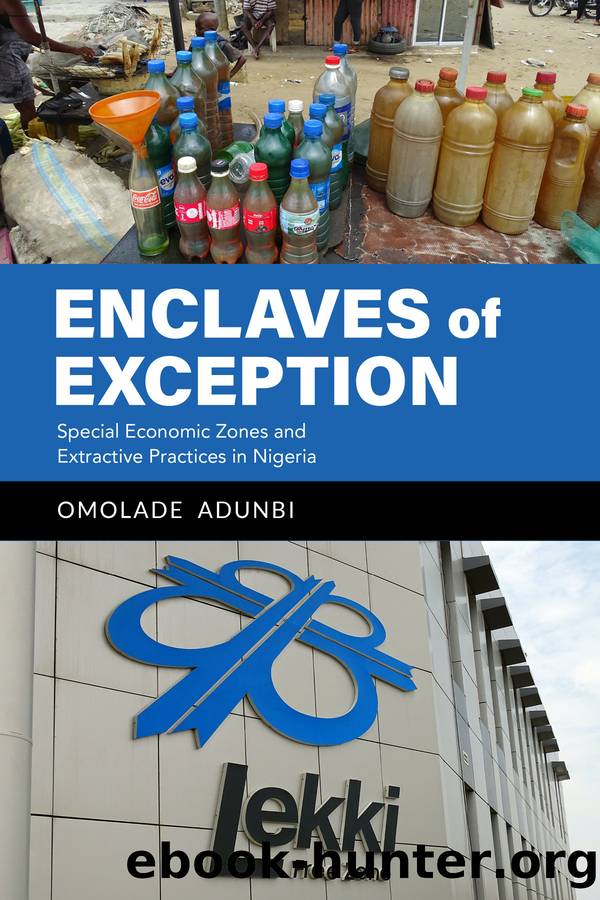
Author:Omolade Adunbi [Adunbi, Omolade]
Language: eng
Format: epub
Tags: International Relations, Trade & Tariffs, Africa, Infrastructure, Political Science, Business & Economics, History, General
ISBN: 9780253059567
Google: psRLEAAAQBAJ
Goodreads: 58734108
Publisher: Indiana University Press
Published: 2022-05-03T08:32:21+00:00
Fig. 4.1 Ogogoro refining in one of the Niger Delta communities. Source: Photograph by the author.
Jimmyâs family has been in the ogogoro business for a very long time. Jimmy, who is in his late twenties, narrated how he grew up being part of the ogogoro business in his village. His grandfather told him how his great-grandfather was an Ãgún devotee and a palm wine tapper who was one of the earliest people to make the transition from tapping and selling palm wine to brewing ogogoro in the village. Over time, it became a tradition passed from one generation to the next. His grandfather passed the tradition to his father, who in turn passed it to him. The only difference today is that Jimmy has succeeded in using the same ogogoro refining technology in the making of artisanal refineries. In Jimmyâs compound, where his father still lives,13 there is a small space designated as an Ãgún shrine in one corner of the compound. The shrine is composed of iron and other materials. Interestingly, Jimmy told me they are all Christians in his family but that members of his family also believe you cannot forget your family heritage; hence, they still worship Ãgún but also go to church on Sundays. Jimmy has his own house but spends most of his time at his family compound when he is not working. The importance of the shrine to the work he does, Jimmy says, is that âÃgún takes part in our everyday activities. Ãgún owns all the tools we use in making ogogoro as well as the tools we use in building infrastructure for our refineries. Remember, Ãgún is the god of iron. In fact, he made the bike that brought you here possible.â14 While Jimmy has become an oil mogul, as he likes to call himself, one of his brothers still helps in sustaining the ogogoro business in keeping with the family tradition. Jimmyâs mother is one of the several women who sell it in the village.
Interestingly, there is a gender-based division of labor in terms of the brewing and selling of ogogoro. While the men brew the product (I should also note that there are a few women who also brew because it is mainly a family business), the women sell it in their shops or market stalls. The same parallel, as I explain in the next chapter, is also applicable to refined oil. Men mostly work in refining the crude, while women mostly work in the retail part of the business. Remarkably, in Jimmyâs village, I also saw many women display ogogoro simultaneously with engine oil, which is a by-product of the refined crude oil. In some instances, gasoline would also be displayed for sale by the women who sell ogogoro. It should be noted that ogogoro and gasoline (including engine oil and kerosene) are not displayed side by side because of the inherent danger in doing so. The women who have mastered the trade know very well that putting both products together on the same stall could create health problems.
Download
This site does not store any files on its server. We only index and link to content provided by other sites. Please contact the content providers to delete copyright contents if any and email us, we'll remove relevant links or contents immediately.
| Arms Control | Diplomacy |
| Security | Trades & Tariffs |
| Treaties | African |
| Asian | Australian & Oceanian |
| Canadian | Caribbean & Latin American |
| European | Middle Eastern |
| Russian & Former Soviet Union |
The Secret History by Donna Tartt(19089)
The Social Justice Warrior Handbook by Lisa De Pasquale(12190)
Thirteen Reasons Why by Jay Asher(8910)
This Is How You Lose Her by Junot Diaz(6887)
Weapons of Math Destruction by Cathy O'Neil(6281)
Zero to One by Peter Thiel(5802)
Beartown by Fredrik Backman(5754)
The Myth of the Strong Leader by Archie Brown(5508)
The Fire Next Time by James Baldwin(5446)
How Democracies Die by Steven Levitsky & Daniel Ziblatt(5219)
Promise Me, Dad by Joe Biden(5153)
Stone's Rules by Roger Stone(5088)
A Higher Loyalty: Truth, Lies, and Leadership by James Comey(4964)
100 Deadly Skills by Clint Emerson(4925)
Rise and Kill First by Ronen Bergman(4789)
Secrecy World by Jake Bernstein(4753)
The David Icke Guide to the Global Conspiracy (and how to end it) by David Icke(4720)
The Farm by Tom Rob Smith(4513)
The Doomsday Machine by Daniel Ellsberg(4490)
